

Digital protector of Xi'an City Wall in China's Shaanxi

Zhao Bin tests an AR telescope equipment on the Xi'an City Wall in Xi'an, northwest China's Shaanxi Province, Jan. 4, 2026.
Xi'an City Wall, initially erected some 1,400 years ago -- in 582 A.D., during the Sui Dynasty, now stretches 13.74 kilometers encircling the city of Xi'an in northwest China's Shaanxi Province. As one of the largest, oldest and best-preserved ancient urban fortifications in China, it once faced great challenge in preservation and protection, as its interior structure -- mostly tamped earth -- has been eroded by wind and rain throughout time.
Nowadays, the problem is largely solved by AI in Xi'an, with the wall modeled with centimeter-level precision into a digital twin system through more than 3,000 monitoring points and over 1,300 visual sensors installed along the wall. Currently, this digital twin system, along with other data, restoration records and visitor operation information, is managed by a "super brain" called the "Xi'an City Wall Digital Cabin Comprehensive Management Platform," which anticipates potential risks by tracking subtle signs of structural strain.
"This 'Digital Cabin', which fully utilizes existing facilities and resources, was finally realized thanks to the support of experts, scholars, and 14 joint laboratories in the field of wall preservation," said Zhao Bin, director of the Xi'an City Wall Digital Industry Innovation Center, who spearheads the execution of the "Digital Cabin."
Zhao Bin, born in 1988 in Huayin of Shaanxi, has been working in the field of culture, tourism, and digitalization industries for 14 years. After completing his undergraduate studies in 2011, he first worked on brand operations at the Huashan Mountain Scenic Spot. Later, he was engaged in cultural and tourism promotion in Weinan and management of digital assets for cultural and tourism sites in Hangzhou. "In 2023, I returned to Xi'an and participated in the preservation of the city wall, overseeing the implementation of the 'Digital Cabin' project," Zhao Bin said. Through the years, Zhao Bin has successfully promoted the digital transformation of multiple cultural heritage projects.
"After all these years, my deepest realization is that cultural heritage is not just an antique to be displayed. It needs to be brought to life through digital technology," Zhao Bin said, "However, people in this field cannot work by themselves. We need resource integration, bold thinking, and experimentation to truly merge digital technology with cultural heritage." According to Zhao Bin, with the collaboration of experts and scholars from various fields, the "Digital Cabin" has now been fully upgraded. It not only plays a crucial role in monitoring and providing early warning for cultural heritage preservation, but also leverages its advantages in cultural tourism operations, emergency safety, and flood control.
Looking ahead, Zhao Bin believes that the digitalization of cultural heritage will evolve from "single-point innovations" to "comprehensive system upgrades." He said he planned to compile the experience of Xi'an City Wall into a replicable model to help more cultural heritage institutions and high-rated scenic areas in China avoid unnecessary detours. "I also hope this 'Chinese solution' can go global, allowing cultural heritage sites in the world to benefit from China's digital technology," said Zhao Bin. (Xinhua)
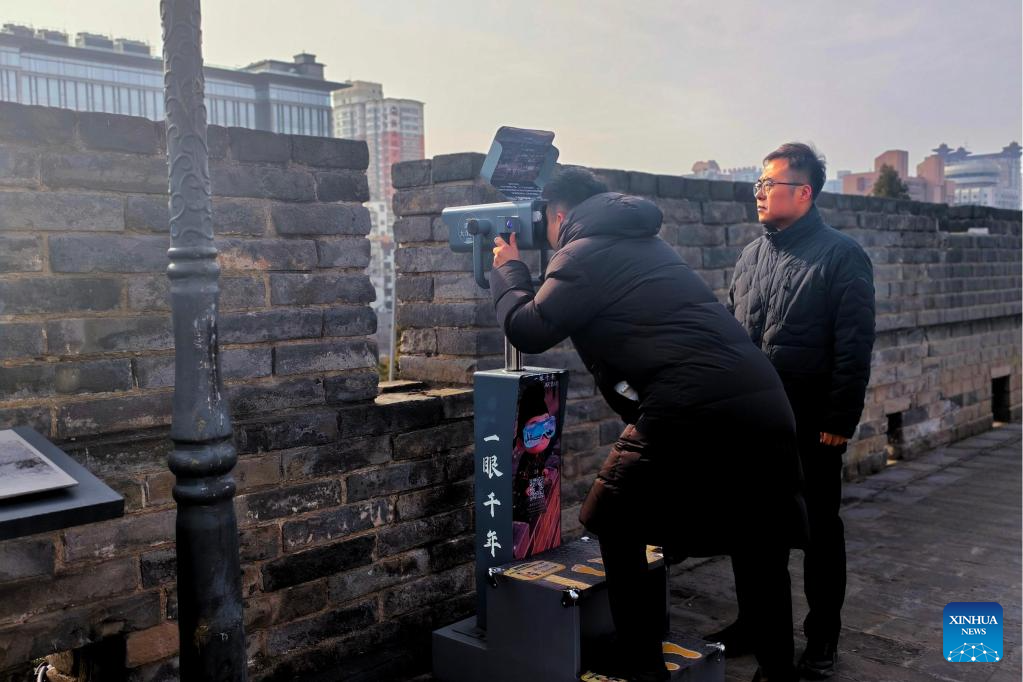
Zhao Bin (R) tests an AR telescope equipment with his colleague on the Xi'an City Wall in Xi'an, northwest China's Shaanxi Province, Jan. 5, 2026. (Xinhua)

This file photo taken in November, 2024 shows Zhao Bin sharing his experiences and ideas in the protection and revitalization of ancient city walls at a conference of the International Ancient City Walls and Castles Alliance in Guangzhou, south China's Guangdong Province. (Xinhua)
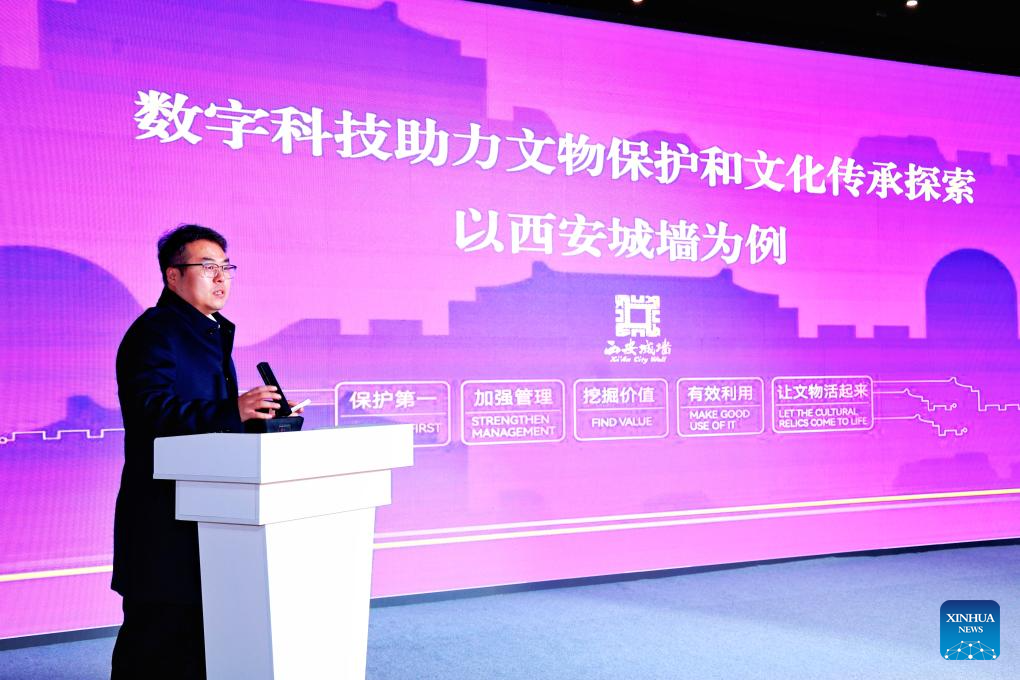
This file photo taken in November, 2023 shows Zhao Bin sharing his experiences and ideas in the protection and revitalization of ancient city walls at a conference of the International Ancient City Walls and Castles Alliance in Chengdu, southwest China's Sichuan Province. (Xinhua)
