
Three keywords to understand the latest development of China-Europe freight trains
2025-12-15 14:55:17 , Source : People's Daily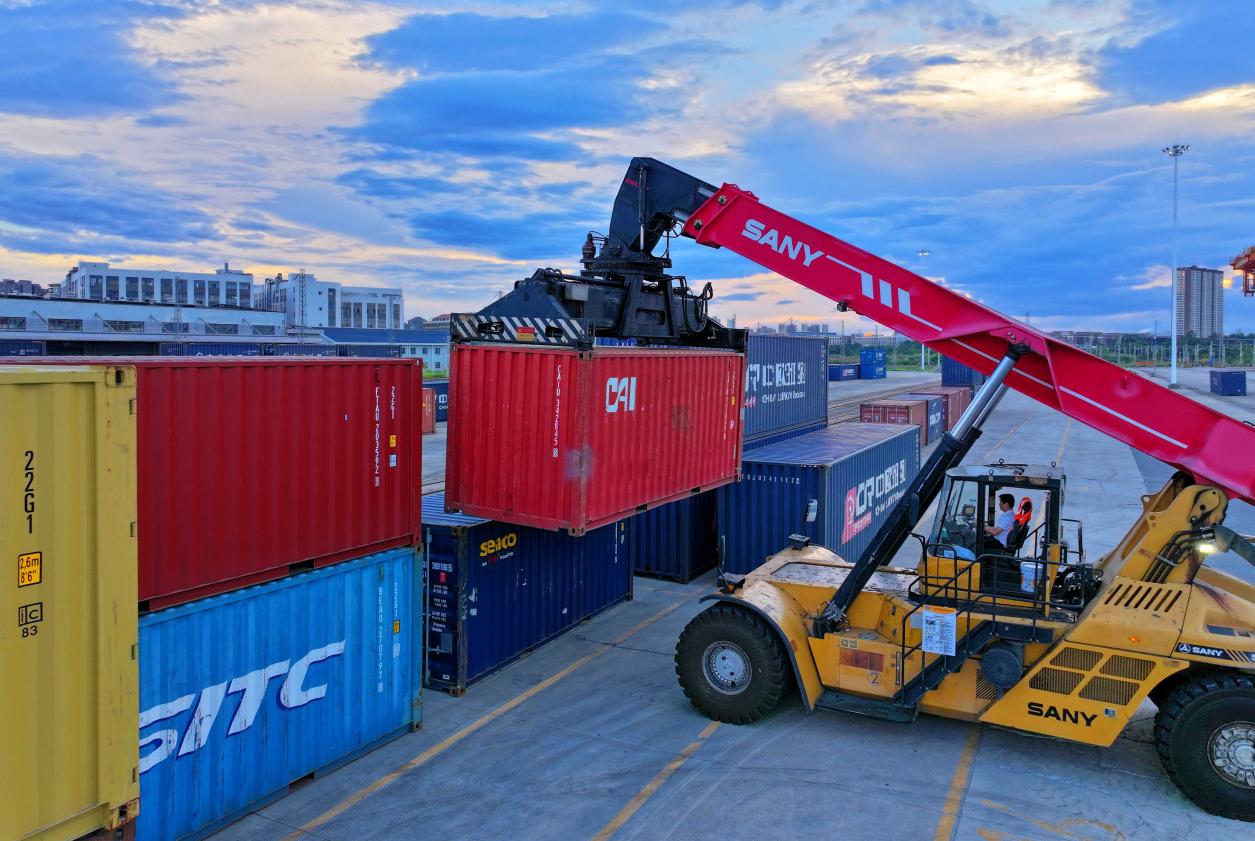
Containers transported by China-Europe freight trains are handled at an international land port in Ganzhou, east China's Jiangxi province. (Photo/Zhu Haipeng)
By Nov. 28, China-Europe freight trains have made a cumulative 120,000 trips and transported goods with a total value exceeding $490 billion. The types of goods transported have expanded to 53 categories that cover more than 50,000 kinds of products.
The following three keywords provide insight into the evolving landscape of the China-Europe freight train service:
Full Timetable Service
The full timetable service enables China-Europe freight trains to operate on pre-scheduled timetables, including designated train numbers, routes, departure times and arrival times across countries along the route.
In November, China State Railway Group incorporated a fourth batch of China-Europe freight trains into the full timetable service. With this update, 17 routes now operate under the full timetable service model, with 22 daily departures, including 8 returning trips, exceeding 1,000 annual journeys.
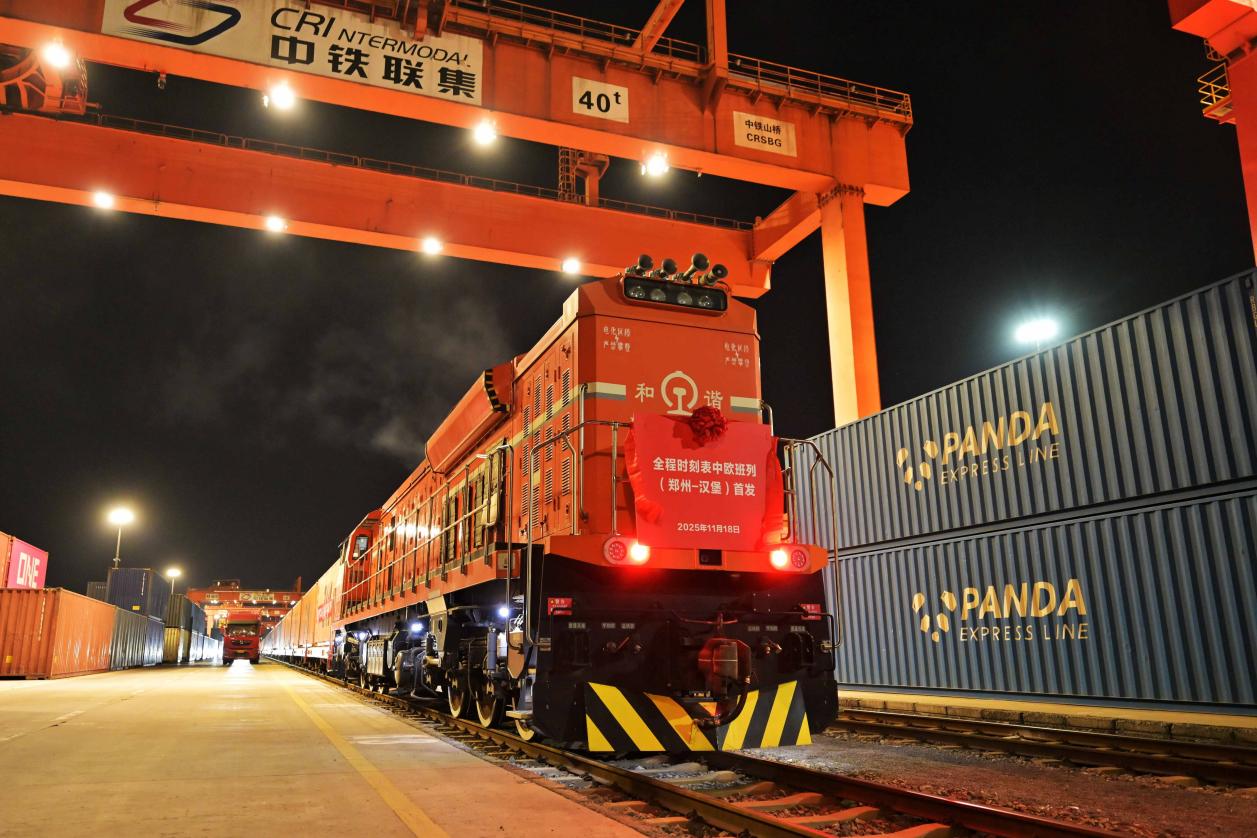
The first China-Europe freight train operating under the full timetable service model in Zhengzhou, central China's Henan province, X8003, is about to depart, Nov. 18, 2025. (Photo/Wang Wei)
What advantages does the full timetable service offer?
Faster transit: Trains operating under the full timetable model reduce travel time by over 30 percent on average compared to regular services on the same routes, significantly improving delivery efficiency.
Operational reliability: With standardized departure points, routes, schedules, and train numbers, the full timetable service enhances predictability and facilitates streamlined logistics planning. "Metro-style operations and transparent pricing allow Chinese products to expand more effectively into European markets while improving access for high-quality European goods entering China," said Li Baozhou, director of the command Center at the Xi'an West Railway Station.
Higher cargo value: The average value of goods per container transported under the full timetable service model is 41 percent higher than that of conventional trains, reflecting the service's ability to attract higher-value shipments.
Corridors
As of the end of October, a total of 128 Chinese cities have launched China-Europe freight train service, reaching 232 cities in 26 European countries and over 100 cities in 11 Asian countries, covering nearly the entire Eurasian region.
Within China, China-Europe freight trains primarily operate along three corridors: The western corridor passes through Alashankou and Horgos in northwest China's Xinjiang Uygur autonomous region, which handled 7,749 trains in the first ten months of this year, or over half of the Chinese national total. The central corridor passes through the Erenhot port in north China's Inner Mongolia autonomous region, and the eastern corridor traverses Manzhouli, Suifenhe, and Tongjiang in northeast China.
Beyond China, three international corridors have been established to enhance connectivity.
The northern corridor connects Mongolia, Russia, and Belarus via ports such as Erenhot, Manzhouli, Suifenhe, and Tongjiang, linking directly to Europe through broad-gauge railways. The central corridor runs through Alashankou and Horgos, connecting to Kazakhstan's broad-gauge railways and merging with the northern route within Russia. The southern corridor also departs through Alashankou and Horgos, linking with Kazakhstan, the Caspian Sea ferry routes, Azerbaijan, and Georgia, before reaching Europe via Turkish railways or Black Sea sea-rail transport.
This multilayered corridor system underpins the growing scale and strategic importance of the China-Europe freight train network.
Value of Goods
The China-Europe freight train service has opened new trade channels for inland Eurasian regions, significantly advancing economic cooperation. From 2013 to 2024, the value of goods transported by the trains grew by about 33 times, with the trains' share in China-Europe trade rising from 0.4 percent to 8.5 percent.
Nankang district, a major timber consumer in Ganzhou, east China's Jiangxi province, imports 80 percent of its nearly 10 million cubic meters of annual timber demand.
"The China-Europe freight train service has reduced transit times for timber imports from Europe to just 12 days, 25 days faster than traditional sea transport, while lowering overall logistics costs by 18 percent," said Ye Zhangnan, manager of the Ganzhou office of the Nanchang railway logistics center.
Through an integrated model that brings together port operations, bonded services and cross-border trade at the Ganzhou International Land Port, Nankang's furniture industry has secured over 5 billion yuan ($708.41 million) in overseas orders, enabling it to "source timber globally and sell furniture worldwide."
The freight network is also transforming retail logistics. For instance, a German tourist named Anna ordered a piece of tablecloth in China, which was delivered to her home in Germany within three days. This rapid fulfillment is made possible through overseas warehouse networks established along the freight corridors.
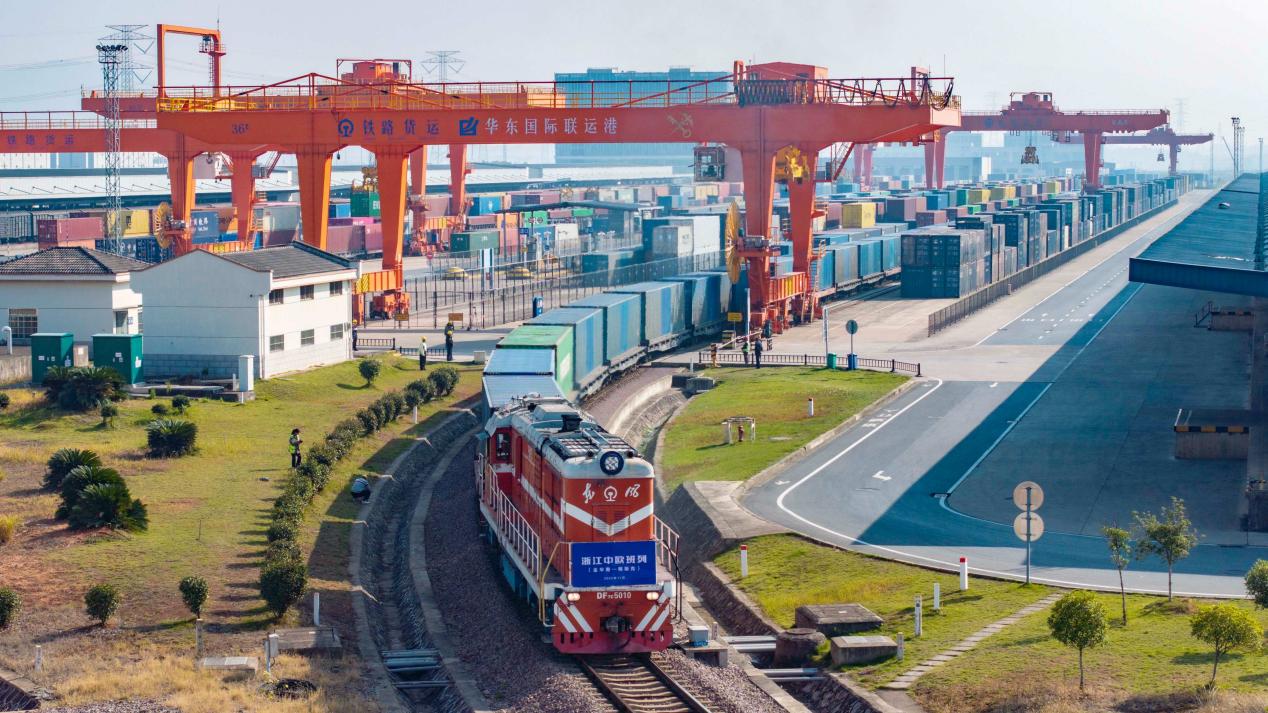
A fully loaded China-Europe freight train departs from Jinhua, east China's Zhejiang province, Nov. 22, 2025. (Photo/Chen Ye)
"With strong transport capacity, we can pre-stock Chinese goods in overseas warehouses and enable local delivery, significantly improving order fulfillment," said Song Penghui, sales manager of a logistics company based in central China's Henan province, whose overseas warehouse network now covers 25 European Union countries.
Meanwhile, landlocked countries such as Kazakhstan, Uzbekistan, and Mongolia have gained access to maritime routes via the freight network. Chinese cities including Chongqing, Xi'an, Zhengzhou, and Wuhan have experienced robust growth in their export-driven industries.
Looking ahead, an executive from China State Railway Group confirmed that China will continue collaborating with partner countries to maintain and expand freight corridors, advancing the development of a more diversified and resilient logistics system.

Government Organizations

Other Links

Copyright@www.shaanxi.gov.cn All Rights Reserved
Registration Number:陕ICP备10004160号